Slate.
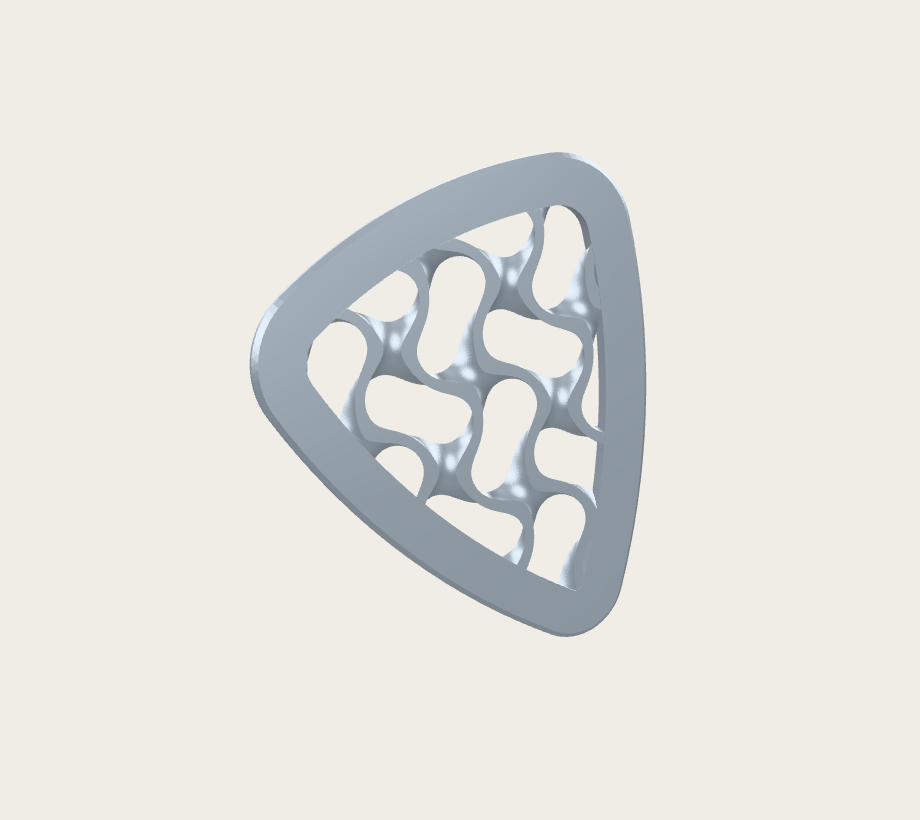
CAD renderFor an easy-flowing, more flexible playing feel. Light on the strings, with the unmistakable NXWRX lattice.
CHORD
Get in touch ↗
Properties built into the lattice, not just the thickness.
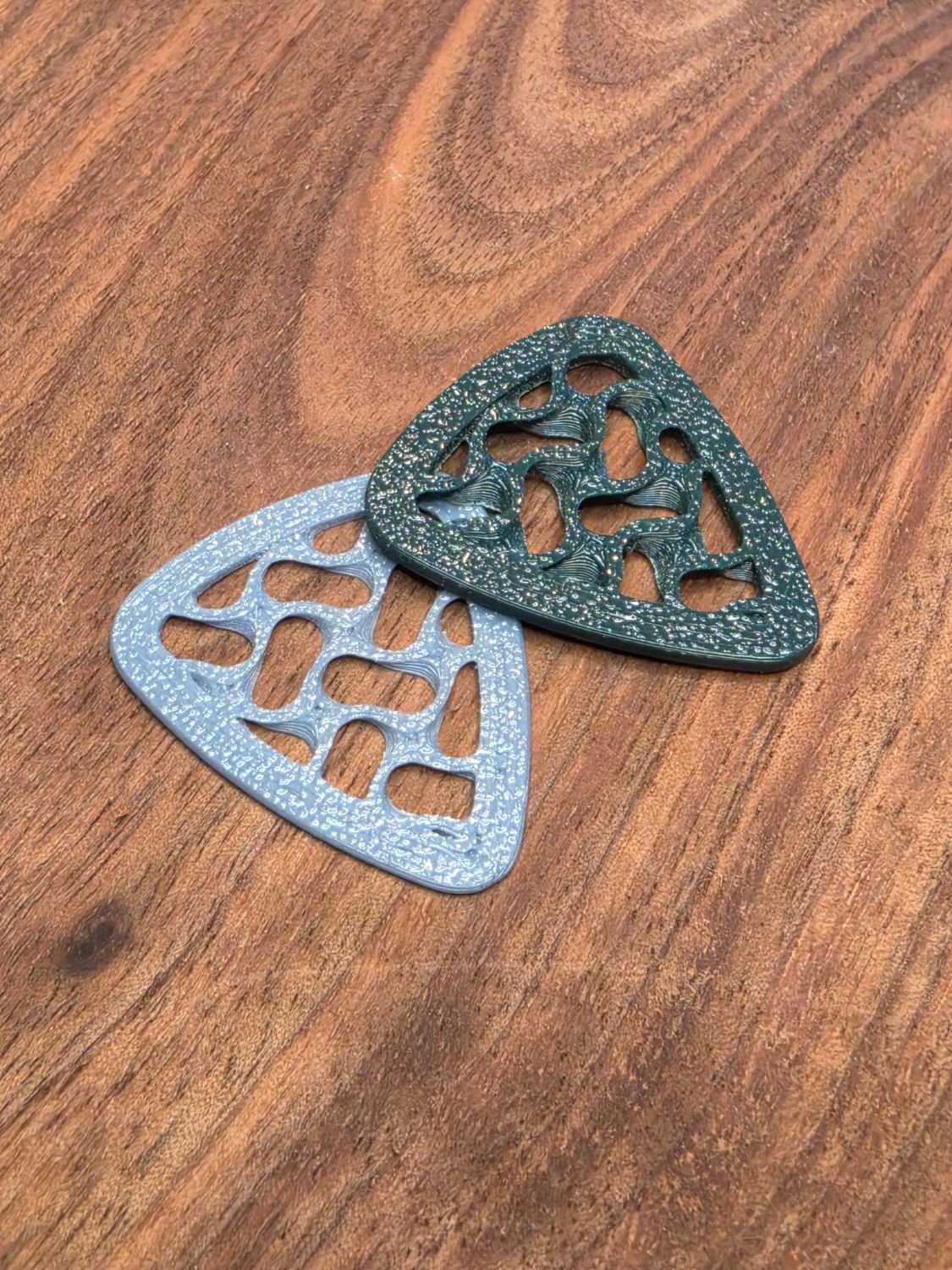
One for players who prefer flexibility. One for a more substantial, controlled response. Both built around a distinctive lattice geometry.

For an easy-flowing, more flexible playing feel. Light on the strings, with the unmistakable NXWRX lattice.

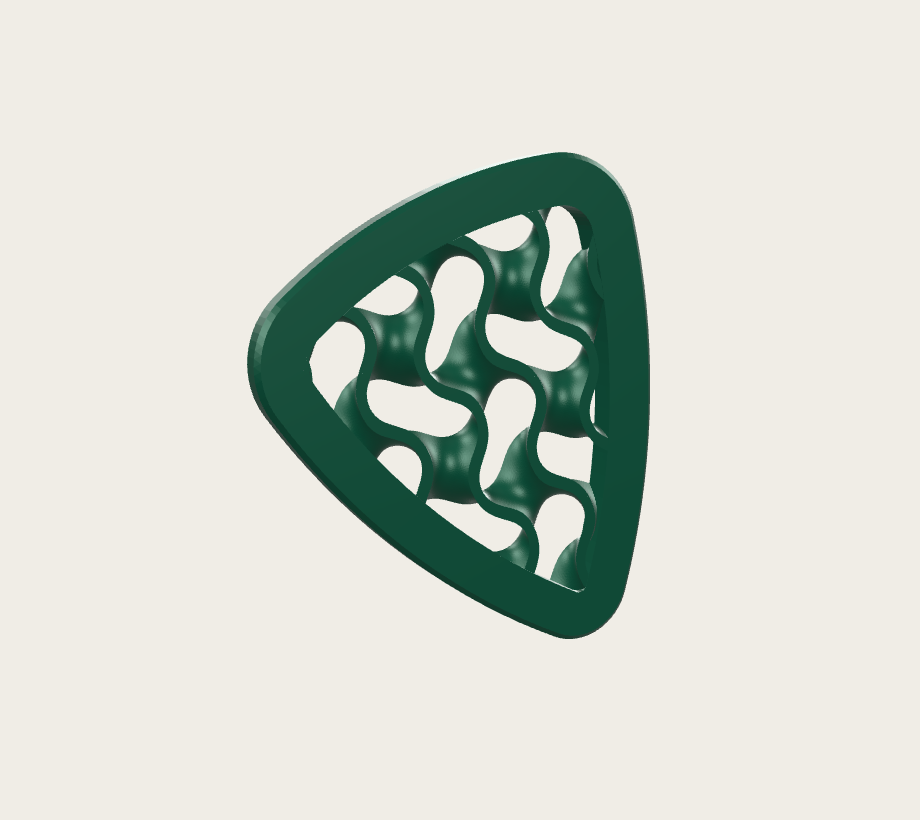
For a more assertive attack and firmer response. The same geometric language, tuned for a different playing style.
What appears simple from across the room becomes something very different up close.

A conventional pick gets stiffer as it gets thicker. But a more substantial grip doesn't have to mean the same internal structure everywhere.
By using additive manufacturing to create a rim-and-lattice design, we're exploring a way to tune flexibility through geometry while preserving the tactile benefits of a pick that's comfortable to hold.
Rim and lattice architecture provide new ways to tune the structure.
Complex internal features become practical to produce without conventional tooling.
Digital simulations guide development; hands-on playing and durability testing remain essential.
Not a pattern for appearance alone. In our initial finite element analysis, geometry measurably changed the calculated bending response.
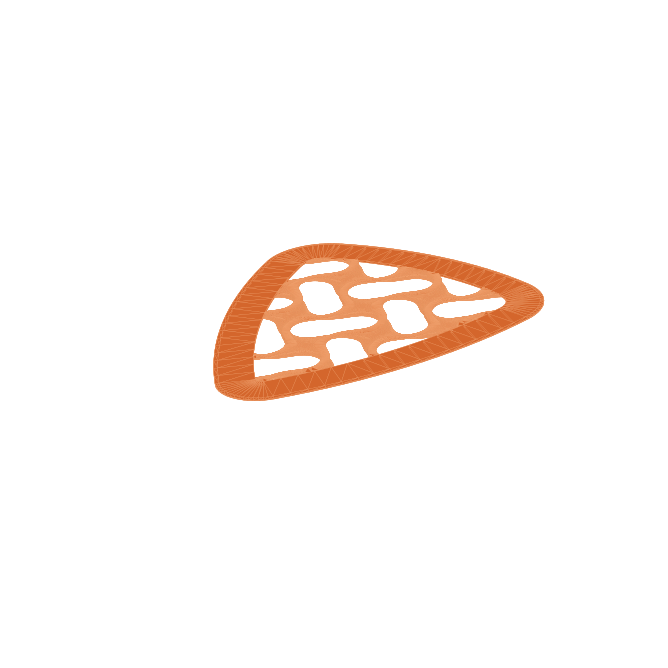
At 1.0 mm thickness and the same applied tip load, we compared a rim-only design with the same rim joined to a gyroid lattice. The added lattice carried part of the load and increased modeled stiffness.
Equivalent to approximately 18.4% less tip deflection under the same load. This is a numerical result; playing feel has not been measured.


We targeted recognizable flexible and firm pick categories while developing a distinct rim-and-lattice architecture. These comparisons use modeled stiffness under a common test fixture. They make no claim of identical tone or feel.
Slate is near the flexible nylon range in this preliminary calculation, with geometry and material differing from a conventional solid pick.
Slate: thickness-scaled estimate. Nylon reference: scaled from the solved 0.60 mm control; assumed E = 2.0 GPa.Grove approaches a familiar firm-pick stiffness category while using a lattice architecture and a greater nominal thickness.
Grove: solved FE result. Acetal reference: cubic thickness scaling from an approximate 1.14 mm benchmark; assumed E = 2.9 GPa.Predicted stiffness = force ÷ mean tip deflection, in N/mm. Fixture: 10 mm fixed grip, 0.1 N applied to a 2 × 2 mm patch near the tip. Models are linear-elastic and isotropic. Comparative reference materials and thickness scaling are assumed. Actual printed stiffness, durability, feel and tone require physical tests. No competing brand endorsement or product equivalence is implied.
After more than two decades working in medical device design and development, I've learned that small changes to geometry can create meaningful changes in how a product behaves.
As we age, getting a reliable grip on everyday objects can become harder. I began thinking about the guitar pick: a thicker pick can be easier to hold, but thickness traditionally drives stiffness as well. Why should those two design decisions be so tightly connected?
That question led me to apply advanced additive manufacturing and engineered lattice structures to a familiar accessory. The result is our first NXWRX Chord collection: two distinctive picks designed for guitar players who value feel, control, and an entirely different approach to structure.
Interested in the picks, the engineering, or following the NXWRX Chord launch? We'd love to hear from you.